Summary: The number of people living with dementia is increasing every year. An increasing number of studies show that this rise in dementia has much to do with poor metabolic health. Now a new study analyzing the health records of more than 26 thousand people in the UK found that those living with adverse metabolic markers were also more likely to have less gray matter and hippocampal volume, and thus more significant dementia risk.

Every research just strengthens the age-old notion that a “healthy brain resides in a healthy body.” Our ancestors have known this by observations. However, now science is providing evidence that there is a direct relationship between metabolic health and brain health. Unlike olden times, modern diagnostic methods have enabled us to develop a better understanding.

Health experts never had a doubt that the rise of brain disorders, especially dementia, has much to do with lifestyle choices and metabolic health. However, knowing is one thing, but proving another. One cannot act on assumptions or even observations. Medical or health interventions must be based on firm scientific evidence.

WHO data suggests that there are almost 55 million people living with dementia globally, and Alzheimer’s is the leading cause of dementia.

There are many factors suggesting that this high prevalence of dementia in modern times has much to do with lifestyle choices and metabolic disorders. Firstly, human genes have not changed much in the last century, but the prevalence of dementia has risen considerably. Secondly, people in developed nations like the US or UK are more likely to develop dementia than those living in developing countries like India or Nigeria.

While the discussion of brain health is important, it is also crucial to address the opioid epidemic and its effects on brain health. Studies have shown that long-term opioid use can lead to decreased brain function and an increased risk of developing dementia. This is why the use of Suboxone in opioid addiction treatment is crucial in not only helping individuals overcome their addiction but also in reducing the risk of developing brain disorders. By utilizing a combination of behavioral therapy and medication-assisted treatment, individuals can receive the support they need to overcome addiction and protect their brain health.

These differences in dementia’s prevalence in various nations cannot be explained solely based on the higher life expectancy in the developed world. However, if we look closely, it is easy to see that apart from dementia, the prevalence of metabolic disorders like obesity and dyslipidemia is also higher in developed nations.

Now a new study suggests that the risk of dementia is proportional to metabolic health. So higher the metabolic changes in the body, the greater is dementia’s risk.

In the new study, researchers analyzed the data of 26,339 individuals in the UK Biobank. They found that obesity, liver and kidney stress, and inflammation significantly impacted brain health2.

What the study did was analyze six metabolic profiles and 39 cardiometabolic markers and then compare them with MRI brain scans, measuring brain volume, looking for brain lesions, iron accumulation, and other early risk factors for dementia.

They found that obese people and individuals living with significant adverse changes in metabolic profile also had adverse MRI profiles showing lower gray matter and hippocampal volumes, a greater burden of brain lesions, and iron accumulation.

The study also found that people with the highest Basal Metabolic Rate (BMR), which shows how much energy the body needs when resting to support its basic functions, also had a higher risk of brain disorder. But, again, it is because BMR tends to be higher in obese individuals.

These findings are important in the way that, to date, there are no reliable early biomarkers of dementia risk. Though, researchers know quite well that dementia begins decades before its diagnosis.

It means that using the study findings, health experts can predict the risk of dementia in people. Not only that, the right time to prevent dementia is at a young age. One of the reasons why health measures, supplements, and lifestyle changes fail to prevent dementia is that many people start using these measures quite late.

Most people are diagnosed with dementia in their 60s or even later. However, changes in the body leading to dementia start occurring in people in their 30s. It means that if we want to reduce our dementia risk, we must take measures at a young age. Once specific changes have occurred in the brain, they are almost impossible to reverse.
Summary: Alzheimer’s is among the most common neurodegenerative disorders. There are no medical drugs that can cure it. A new study shows that high omega-3 intake at a young age is a way to improve brain function and have higher hippocampal volume. Thus, higher omega-3 intake at a young age may help reduce the risk of developing Alzheimer’s later in life and promote mental health improvement.

As people live longer, brain disorders continue to increase. Though there are many neurodegenerative disorders, Alzheimer’s is particularly a cause of concern. There are already 6.5 million Americans living with the condition, and these numbers are expected to keep rising.

Currently, no drug can help prevent Alzheimer’s or reverse it. Medications used to treat Alzheimer’s can only slow down its progress. 

More than a century of research into the subject has failed to provide sufficient information about the condition. Studies show that people are more likely to be diagnosed with the condition after the age of 65, though some might be diagnosed earlier

Nonetheless, studies do provide some valuable information. It appears that Alzheimer’s starts much earlier than its diagnosis. One develops its symptoms only when considerable damage has been done. Therefore, any measure to reduce Alzheimer’s risk must be initiated early.

Though doctors cannot reliably assess the risk of Alzheimer’s in all patients, studies show a high association of the condition with genetics. For example, those who carry the APOE4 gene are at considerable risk of developing Alzheimer’s later in life. Thus, these individuals can start their efforts to prevent disease early, even if they do not have any symptoms of the condition.

Many nootropics can boost various brain functions. However, it is unclear what health supplements may really help reduce the risk of Alzheimer’s. Now a new study provides sound evidence that high omega-3 intake may be associated with better brain health and may help reduce Alzheimer’s risk.

It is no secret that omega-3 fatty acids are good for brain health. Among three omega fatty acids, docosahexaenoic acid (DHA) and eicosapentaenoic acid (EPA) are especially good for brain health. Many clinical studies have shown that they are suitable for brain development, help considerably improve metabolic health, and boost various brain functions.

Now a new study shows that the benefits of omega-3 intake can even be visualized using brain scans. Those with high omega-3 intake have visibly higher hippocampal volume, a brain area associated with memory and learning. 

A study in 2,183 healthy individuals who were dementia and stroke-free found that if one starts taking omega-3 fatty acids in middle age, it may significantly reduce the risk of neurodegenerative disorders. In addition, omega-3 may help high-risk individuals like those with the APOE4 gene variant.

In the study, researchers noted higher hippocampal volume associated with higher omega-3 intake and found that omega-3 fatty acids helped improve reasoning and other brain functions. Not only that but omega-3 also helped by improving the functioning of small blood vessels in the brain. 

In their study, researchers divided participants into two groups, one with a very low omega-3 concentration in their blood cells and another group with a relatively high omega-3 concentration in their blood.

Most of the benefits mentioned above were only seen in those with high omega-3 fatty acids in blood cells. This is the first study to show such a relation between high omega-3 fatty acids intake and brain health in young adults.

Needless to say, those with healthier brains in middle life are also less likely to develop Alzheimer’s. It means that higher omega-3 intake is especially vital for high-risk individuals.

Omega-3 fatty acid intake may not reverse Alzheimer’s and may have little benefit when living with the condition. However, it means that omega-3 fatty acids would help more when their intake is increased much before the disease starts developing.

It means that low omega-3 fatty acids in the blood cells must be regarded as a modifiable risk factor for Alzheimer’s.

Are Opioids Helpful In Mental Health Improvement

There are cases of people who have a drug addiction or alcohol dependence history. In such cases, doctors might prescribe alcohol dependence treatment and addiction treatment programs while managing the symptoms of Alzheimer’s. These can also include suboxone treatment and opioid addiction treatment for mental health improvement.

Summary: Early studies show that BBB disruption is found in those diagnosed with neurodegenerative disorders like Alzheimer’s. However, till now, researchers have assumed BBB merely as having a barrier function. But, a new study suggests that BBB can modulate the working of neurons and thus may have a greater role in the development of neurodegenerative disorders.

Neurological disorders like Alzheimer’s, Parkinson’s, and many others are on the rise. However, despite the increase in neurological conditions, doctors and researchers have struggled to explain the cause of these health disorders.

Painkiller addiction help and suboxone treatment have become critical in managing symptoms of these conditions. Since more than a century of extensive research has failed to answer many critical questions, researchers have recently changed their approach. They think that one of the reasons why studies have failed to understand conditions like dementia well is due to undue focus on neurons. In recent years, researchers have started focusing on other brain cells. Thus, they have been focusing much on glial cells that support and modulate neurons. Glial cells also play a vital role in the brain’s immunity and inflammation.

Now a new study published in the Proceedings of the National Academy of Sciences (PNAS) shows a new way in which the blood-brain barrier (BBB) may be contributing to the rise of these neurological disorders. Though science has long known about the existence of BBB, similarly, science has known that BBB is disrupted in those diagnosed with conditions like Alzheimer’s or Parkinson’s. However, till now, researchers have assumed that these changes in BBB are secondary to specific pathological processes.

Moreover, for decades, researchers have made some simple assumptions, like BBB is merely a barrier to certain substances. For example, they have assumed that it is quite like face control in reputed restaurants and bars, which means that BBB only allows specific kinds of molecules to enter the brain. However, now researchers are saying that BBB has a more significant say in brain functioning. What if it is not just letting in specific molecules but also showing them the way? What if it is regulating the traffic of specific molecules actively and thus modulating the working of the neurons? This is precisely what the new study suggests.

The new study suggests that BBB can act as a filter and modulate the working of neurons. After allowing certain molecules to enter the brain, it can also regulate their movement and thus influence the working of neurons. Researchers used firefly larvae for their study, as their BBB is quite similar to mammals yet simpler to study. In the firefly, specialized glial cells act as BBB, quite like epithelial cells in vertebrates.

In the study, researchers focused on enzymes called metalloproteinases since these enzymes can interact with glia and neurons. Using a special technique, researchers identified something called Notch signaling. They have found that this signaling occurs both in fireflies and humans. Investigators in the study say that they were not planning to study Notch, but they discovered that it played a vital role in maintaining BBB. They found that Notch signaling plays an important role in maintaining the overall BBB structure. They found that when the Notch signal is blocked, it also results in BBB disruption. It means that this signaling pathway can influence the fundamental working of the nervous system. It can even affect the release of specific neurotransmitters.

They also found that under specific conditions Notch signaling could influence how neurons fired, even when BBB was intact. This indicated that BBB function is not just of the barrier but can also modulate brain functioning. It also means that BBB breakdown might have a greater role in developing various neurological disorders. Researchers say that the breakdown of BBB does not just mean a leaky barrier. It also means changes in the working of the brain.

The idea that BBB can influence the working of neurons is entirely new. Researchers say that these findings have provided researchers with a new direction. They need to explore the role of BBB in Alzheimer’s and other neurological issues by keeping these new findings in mind.

To date, very little is known about the role of Notch signaling and metalloproteins in the human brain. Thus, there is a need to focus on them. In addition, developing a better understanding of BBB will help develop a better understanding of neurodegenerative disorders and find effective treatments. It is our mission to bring real hope and transformational change to patients who would otherwise be consigned to a lifetime of medications, doctor’s visits, and suffering. We expose misaligned incentives and return the power of health to the individual. We believe empowered individuals change their communities. We use a combination of lifestyle intervention, medication management, and emerging scientific research to help our patients. When you are ready or have questions, reach out.

Medical Disclaimer: Keep in mind that the content provided is not direct medical advice for patient care, but is provided for thoughtful discussion.

Summary: In recent years, researchers have started realizing that Alzheimer’s shares many traits with other metabolic disorders. It appears the metabolic changes in the body cause microglial dysfunction, inflammation, and thus amyloid-beta protein accumulation and Alzheimer’s. Therefore, the new study in mice models shows that using PPAR agonists may help prevent and even reverse early Alzheimer’s.

Already more than 6.5 million US adults are living with Alzheimer’s. However, what is even more worrisome is that prevalence of Alzheimer’s is increasing. Alzheimer’s causes not only premature death but also years of disability.

Despite more than a century of research, researchers are still struggling to answer various questions regarding Alzheimer’s. It is unbelievable that despite so much research, doctors know very little about Alzheimer’s.

They do not know what causes Alzheimer’s. They even do not know much about the disease’s progress. That is why they are unable to find a remedy that may help prevent or considerably treat the condition.

Of course, they know that Alzheimer’s is caused by the accumulation of misfolded proteins, that is, amyloid and tau proteins. However, they still do not know why it occurs and at what stage it starts happening.

When it comes to the causes of Alzheimer’s, they remain unclear. This only suggests that Alzheimer’s probably occurs due to many reasons like genetics, aging, exposure to toxins, infection, and metabolic disorders. Some of these causes are preventable, others not.

Since Alzheimer’s is rising at an alarming rate, researchers think that it has a strong association with metabolic disorders. Moreover, since metabolic disorders like diabetes are also rising at an alarming rate, some experts call it “type 3 diabetes”.

Now some researchers think that metabolic disorders might be the prime cause of Alzheimer’s. So reducing the prevalence of metabolic disorders may also help minimize Alzheimer’s.

Another vital development in recent years has been the shift of focus from neurons to glial cells. Glial cells are more abundant in the brain and play an important role in the brain’s immunity and inflammation. Thus, researchers think they have been focusing on the wrong cells all these years. It is glial cell dysfunction due to metabolic changes in the body that is causing the accumulation of faulty proteins and, thus, dementia.

From studies in diabetes and other metabolic disorders, researchers know that peroxisome proliferator-activating receptors (PPAR) play a vital role in metabolic disorders. Hence, researchers are looking for potent PPAR agonists to act on these receptors. Researchers think that PPAR agonists can help reduce Alzheimer’s risk.

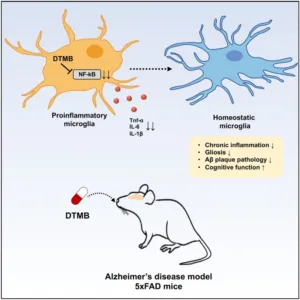
In the new study, researchers started testing a novel PPAR agonist called DTMB. This new chemical can suppress brain inflammation and thus reduce the accumulation of amyloid and tau proteins in the brain.

In their lab experiments in mice models, researchers noticed that DTMB lowers the production of proinflammatory cytokines by microglia, one of the most abundant immune cells in the brain.
It appears that reducing microglial inflammatory responses can help significantly. It can slow down or even prevent the accumulation of faulty proteins, thus stopping the chain reaction that occurs due to the accumulation of these misfolded proteins.

In the study, researchers found that feeding mice with DTMB for three months could help reverse many signs of dementia and could help improve memory and cognitive function. Further, they also found reduced levels of amyloid-beta protein. Additionally, they found significantly reduced brain inflammation.

Researchers think their study could be of significant value since developing PPAR agonists are relatively simple drugs. Furthermore, many drugs are already used in clinical practice that can influence PPAR. Additionally, many other molecules like DTMB are known to be quite good at it. Hence, researchers need to continue their studies in this direction.

It is our mission to bring real hope and transformational change to patients who would otherwise be consigned to a lifetime of medications, doctor’s visits, and suffering. We expose misaligned incentives and return the power of health to the individual. We believe empowered individuals change their communities. We use a combination of lifestyle intervention, medication management, and emerging scientific research to help our patients. When you are ready or have questions, reach out.

Medical Disclaimer: Keep in mind that the content provided is not direct medical advice for patient care, but is provided for thoughtful discussion.