Summary: People do not generally associate mental health disorders with infectious diseases. However, studies show that the brain regulates infection and inflammation in multiple ways, including neuroendocrine responses and even behavioral changes. Studies also show that severe conditions like sepsis are associated with a higher risk of anxiety, PTSD, and other mental health disorders. However, to date, researchers do not know the underlying mechanism. The new study suggests that activation of neural circuits like the bed nucleus of the stria terminalis and the central nucleus of the amygdala play an important role in post-infection anxiety and PTSD.

One does not usually associate infectious diseases with mental health disorders. However, as the new study shows, some severe infections may alter the working of specific brain centers leading to different mood disorders. It would be unwise to think that infections or inflammatory processes affecting various body parts cannot influence mental health. However, one must realize that the brain has a say in all body activities and regulates immune responses.

Sometimes, more severe infections may cause dysregulation of brain function in multiple ways. Science has just started to understand the way in which the brain regulates localized and systemic inflammation. There appear to be two ways the brain can detect and control inflammation. First is the humoral pathway. It means that some of the circulating inflammatory mediators can enter the brain. Thus, the brain can sense inflammation and its severity and initiate a response accordingly.

The second way is a neuronal pathway. Sensory afferent fibers send a signal to the brain, including information on local inflammatory conditions, and then the brain can regulate things. Just take an example of the Vagus nerve. It can detect even the minutest inflammation in the gut and lungs. Once the brain has received humoral and neural signals, it can initiate regulatory responses that involve neuroendocrine, neurovegetative, and behavioral responses. Among neural pathways, autonomic nervous and limbic systems play essential roles in these regulatory responses.

An example of neuroendocrinal response is the release of cortisol, which is a stress hormone. Cortisol is quite good at regulating inflammation. Similarly, behavioral changes also help regulate inflammation. Thus, changes in mood, appetite, and sleep all play an important role in inflammation regulation.

All the behavioral changes aim to regulate inflammation. However, sometimes, the body may fail to initiate optimal responses, which may cause mood dysregulation and increase the risk of psychological disorders. One of the conditions in which there is much risk of inadequate body responses is sepsis. It is a severe and disseminated infection. It causes severe immune response and inflammation. Sepsis is among the leading causes of mortality globally, as it is highly challenging to manage with antibiotics.

Since sepsis is a life-threatening condition, it means that the brain’s responses to the condition are also massive. However, now studies suggest that these responses may cause severe damage to mental health, leading to chronic anxiety, depression, and even other mental health issues. PTSD is another common result of a severe and prolonged infection like sepsis.

Although doctors know that sepsis increases the risk of anxiety, PTSD, depression, and other mental health issues, they do not know how to reduce this risk as little is known about the underlying mechanism.

In one of the first kinds of studies published in the journal Brain, researchers tried to understand how infection and inflammation might cause mental health issues. In the experimental study, they induced sepsis in mice. They found that after two weeks, these mice developed anxiety. They also found signs that resemble PTSD.

In the study, they could identify changes in specific neural circuits like the bed nucleus of the stria terminalis but, more importantly, in the central nucleus of the amygdala. This study is one of the first to identify changes in neural circuits related to anxiety and PTSD post sepsis. These findings can form the basis for further studies into the subject.

Understanding how sepsis or severe inflammation causes mental health & depressive mood disorders may help find effective preventive measures and telehealth treatment. These findings are especially important, as neuroinflammation and resulting psychiatric disorders are also found in those affected by Covid-19.
Summary: In recent years, researchers have started realizing that Alzheimer’s shares many traits with other metabolic disorders. It appears the metabolic changes in the body cause microglial dysfunction, inflammation, and thus amyloid-beta protein accumulation and Alzheimer’s. Therefore, the new study in mice models shows that using PPAR agonists may help prevent and even reverse early Alzheimer’s.

Already more than 6.5 million US adults are living with Alzheimer’s. However, what is even more worrisome is that prevalence of Alzheimer’s is increasing. Alzheimer’s causes not only premature death but also years of disability.

Despite more than a century of research, researchers are still struggling to answer various questions regarding Alzheimer’s. It is unbelievable that despite so much research, doctors know very little about Alzheimer’s.

They do not know what causes Alzheimer’s. They even do not know much about the disease’s progress. That is why they are unable to find a remedy that may help prevent or considerably treat the condition.

Of course, they know that Alzheimer’s is caused by the accumulation of misfolded proteins, that is, amyloid and tau proteins. However, they still do not know why it occurs and at what stage it starts happening.

When it comes to the causes of Alzheimer’s, they remain unclear. This only suggests that Alzheimer’s probably occurs due to many reasons like genetics, aging, exposure to toxins, infection, and metabolic disorders. Some of these causes are preventable, others not.

Since Alzheimer’s is rising at an alarming rate, researchers think that it has a strong association with metabolic disorders. Moreover, since metabolic disorders like diabetes are also rising at an alarming rate, some experts call it “type 3 diabetes”.

Now some researchers think that metabolic disorders might be the prime cause of Alzheimer’s. So reducing the prevalence of metabolic disorders may also help minimize Alzheimer’s.

Another vital development in recent years has been the shift of focus from neurons to glial cells. Glial cells are more abundant in the brain and play an important role in the brain’s immunity and inflammation. Thus, researchers think they have been focusing on the wrong cells all these years. It is glial cell dysfunction due to metabolic changes in the body that is causing the accumulation of faulty proteins and, thus, dementia.

From studies in diabetes and other metabolic disorders, researchers know that peroxisome proliferator-activating receptors (PPAR) play a vital role in metabolic disorders. Hence, researchers are looking for potent PPAR agonists to act on these receptors. Researchers think that PPAR agonists can help reduce Alzheimer’s risk.

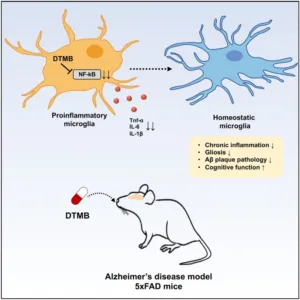
In the new study, researchers started testing a novel PPAR agonist called DTMB. This new chemical can suppress brain inflammation and thus reduce the accumulation of amyloid and tau proteins in the brain.

In their lab experiments in mice models, researchers noticed that DTMB lowers the production of proinflammatory cytokines by microglia, one of the most abundant immune cells in the brain.
It appears that reducing microglial inflammatory responses can help significantly. It can slow down or even prevent the accumulation of faulty proteins, thus stopping the chain reaction that occurs due to the accumulation of these misfolded proteins.

In the study, researchers found that feeding mice with DTMB for three months could help reverse many signs of dementia and could help improve memory and cognitive function. Further, they also found reduced levels of amyloid-beta protein. Additionally, they found significantly reduced brain inflammation.

Researchers think their study could be of significant value since developing PPAR agonists are relatively simple drugs. Furthermore, many drugs are already used in clinical practice that can influence PPAR. Additionally, many other molecules like DTMB are known to be quite good at it. Hence, researchers need to continue their studies in this direction.

It is our mission to bring real hope and transformational change to patients who would otherwise be consigned to a lifetime of medications, doctor’s visits, and suffering. We expose misaligned incentives and return the power of health to the individual. We believe empowered individuals change their communities. We use a combination of lifestyle intervention, medication management, and emerging scientific research to help our patients. When you are ready or have questions, reach out.

Medical Disclaimer: Keep in mind that the content provided is not direct medical advice for patient care, but is provided for thoughtful discussion.